
Request A Catalogue

Please fill out your details and select which catalogues you wish to receive.

Catalogue(Required)

Search

Enter your search term below

Finger Splints – A Simple Guide For Injured Fingers

Finger injuries and long term conditions in the hand are common. A correctly chosen finger splint protects the joint, reduces pain and supports healing so you can return to everyday tasks more easily.

What finger splints do

A finger splint holds one or more joints still in a safe position. This reduces strain on ligaments, tendons and bone, controls swelling and pain, and helps tissues heal in good alignment.

Splints are used for
• Sprains and stable fractures
• Tendon problems such as mallet finger or trigger finger
• Joint instability or deformity including swan neck and boutonniere
• Arthritis in the fingers and thumb

When and how long to wear a splint

Your healthcare professional will set the plan, but the pattern is usually

• Acute injuries such as fractures or fresh tendon damage
Worn all the time, including at night, for several weeks so the finger is protected at every stage.

• Longer term problems such as arthritis or mild tendon irritation
Worn for specific tasks or flare ups to reduce load on the joint.

Too much immobilisation weakens muscles and stiffens joints, so splinting is usually combined with simple exercises once it is safe to move. Always follow the advice given by your clinician.

Choosing a finger splint

Three points matter most

  1. Diagnosis
    The splint must match the injury or condition. A splint suitable for a fracture is not necessarily right for a tendon injury or arthritis.

  2. Fit and comfort
    A good splint feels snug but not tight. Numbness, tingling, colour change or increased pain are warning signs and should be checked.

  3. Materials and hygiene
    Smooth edges, soft padding and easy cleaning help prevent skin problems, especially when the splint is worn for long periods.
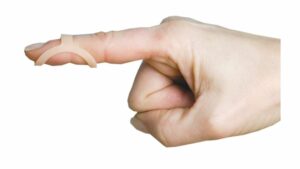
KSA finger splint highlights

Kettering Surgical Appliances supplies a focused range of finger splints used by clinicians across the NHS and private practice. Below are examples you can discuss with your healthcare professional.

Infinite Loop Finger Splint
Treat up to six different injuries with one adjustable splint. A simple turn changes the application, so the same device can support swan neck or boutonniere deformity, mallet finger, trigger finger, lateral instability, contracture management and more. Broad bands spread pressure for comfort and the seamless molded plastic with open design reduces skin problems. Two splints can be combined when full immobilisation is required.

KSA Mallet Finger Splint
Durable beige plastic splint to protect fingertip and nail bed injuries and treat mallet finger. It holds the distal joint straight so the tendon or fracture can heal in good position. Strap or tape in place. Sized by inside width and length for a close fit.

Frog Splints
Premium finger fracture splints with smoothed metal edges and foam lining. Frog Splints stabilise and align the interphalangeal joint after ligament injury while padding protects the skin. Supplied in packs of twelve for clinic or ward use.

Baseball Splints
Part of the same premium padded metal range. Baseball Splints stabilise distal phalanx fractures and protect the fingertip and nail. Buffed edges and foam lining maximise comfort. Supplied in packs of twelve.

Finger Strips
Long premium fracture strips that can be cut and shaped to immobilise fractured fingers along their length. Metal edges are buffed smooth and lined with foam. Pack of twelve, length eighteen inches, for versatile use across multiple finger injuries.

Bedford Finger Splint
Made from elasticated latex free stockinette, Bedford Finger Splints provide firm support and light protection for injured fingers while allowing some movement. Comfortable for day to day wear when full rigid immobilisation is not required.

Finger Cot Splint
A fingertip splint that comfortably immobilises the distal joint and protects the nail edge. It adjusts to accommodate swelling and includes straps for secure positioning, ideal after crush injuries or distal phalanx fractures when soft tissue protection is important.

Finishing point

The right splint, fitted correctly and worn for the right length of time, makes a clear difference to comfort and recovery. Work with your clinician to choose the most suitable option from the KSA range and seek advice promptly if you notice increased pain, swelling or changes in sensation while the splint is on.